The Decoder / One term

What is Nano Banana?

Nano Banana is Google's name for the image model inside Gemini. It draws pictures from a description, edits photos you upload and keeps a character consistent across images; Nano Banana 2 is free in the Gemini app.

By Mstimaj Numbers checked 6 November 2026 Updated 6 November 2026 Level Start Here

Sign in to save your place and mark this done. Free, no card.

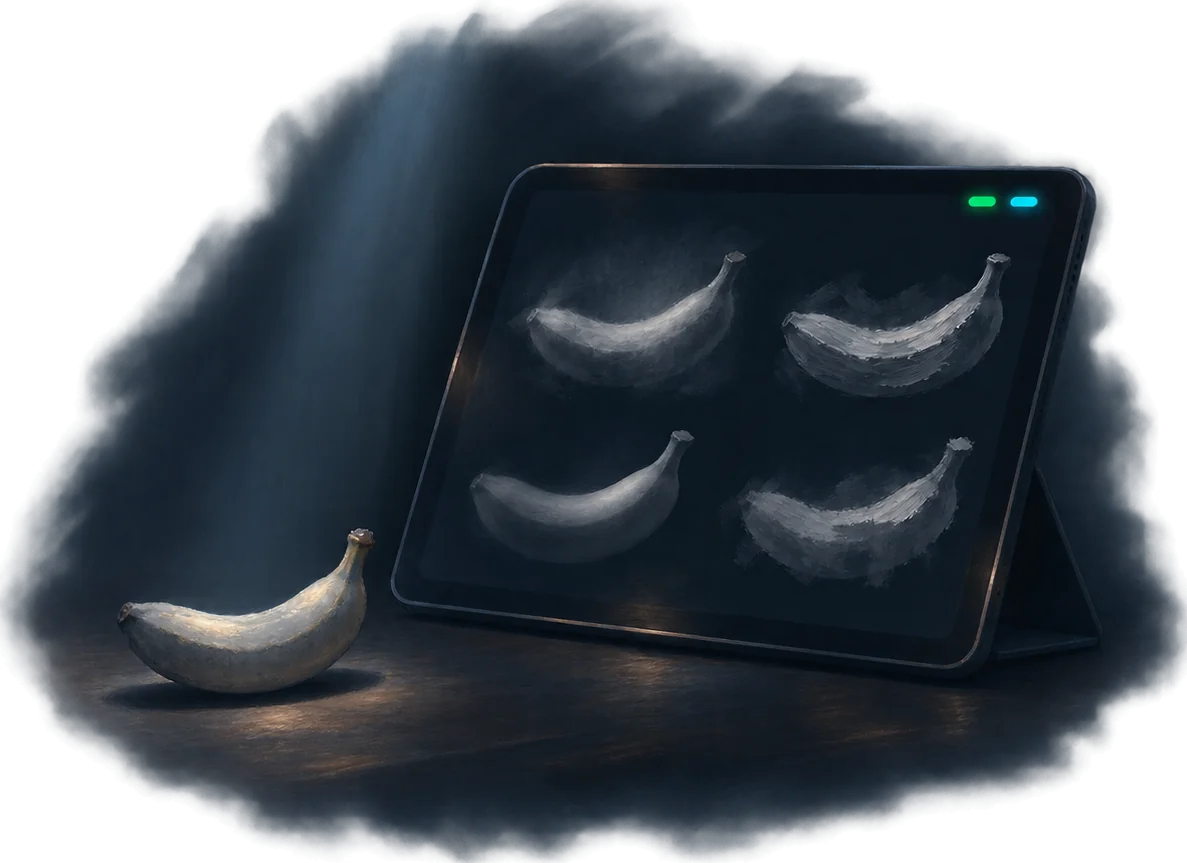
A single small banana on a dark desk next to a tablet showing the same banana redrawn in four different styles

It is a product name, not a fruit. Nano Banana is what Google calls the image generation model inside Gemini. You type what you want and it draws it, or you upload a photo and ask for changes. It is known for keeping a person or character consistent across several images and for putting readable text inside a picture. Nano Banana 2 is free in the Gemini app; Nano Banana 2.1 comes with a Google AI plan.

Key facts

  • $0for Nano Banana 2 in the Gemini app, with higher limits on paid plans
  • $19.99a month, Google AI Pro, the plan Google lists with higher Nano Banana access
  • $0.067per 1K image for Nano Banana 2 through the developer API
  • 2watermarks on every image: an invisible SynthID one and a visible one
  • gemini.google image generation overview, gemini.google/subscriptions, and the Google AI Studio pricing page for API prices; all read 6 November 2026

Is Nano Banana the same thing as Gemini?

Gemini is the whole assistant: the chat, the writing, the research. Nano Banana is the part of it that makes pictures. Google gave the image model its own name, the way a car company names an engine, so you will see both words on the same screen. In the Gemini app you do not pick Nano Banana from a menu; you ask for an image and that is what draws it. On the developer side the same model appears under its technical names, which is where the per-image prices come from.

The Nano Banana versions and where each one lives
Name Where Cost
Nano Banana 2 Gemini app, free tier $0, with a cap
Nano Banana 2.1 Gemini app on a Google AI plan from $4.99 a month
Nano Banana Pro Google Search, limited free access $0, limited
Nano Banana 2 and 2.1 (API) Google AI Studio, for developers from $0.0336 per 1K image

What can it actually do?

Google’s overview lists image generation, editing, blending several photos into one, character consistency, text rendering, and precise adjustments such as lighting and camera angle. The two that matter most in practice are character consistency and text rendering. Character consistency means you can make a picture of a person or a mascot and then make five more of the same person in different scenes without their face changing. Text rendering means a sign, a label or a headline inside the picture comes out spelled correctly, which image models used to be bad at.

What does it cost?

In the Gemini app, Nano Banana 2 is free and the paid plans raise the cap. Google AI Plus is $4.99 a month, Google AI Pro is $19.99, and Ultra starts at $99.99; Google describes Pro and Ultra as higher and highest access to Nano Banana. For developers paying per picture through the API, Nano Banana 2 is $0.067 for a 1K image and $0.101 for 2K; Nano Banana 2.1 is $0.0336 at 1K. So a hundred ordinary pictures through the API cost a few dollars. Prices are the ones on Google’s pages on the date above.

API price per 1K image, in cents API PRICE PER 1K IMAGE, IN CENTS Nano Banana 2.1 3.4 cents Nano Banana 2 6.7 cents
What a developer pays per picture. In the Gemini app you pay by the month instead.

How do I tell if an image came from it?

Every image carries two marks. One is visible. The other is SynthID, an invisible watermark in the pixels that survives cropping and resizing. Google says you can upload an image to Gemini and ask whether Google AI made it, and it will check for the mark. That is the honest answer to a question people ask the other way round, which is whether anyone can tell. For Gemini images, Google can, and so can you.

Filed under Level: Start Here

Ask what did not make sense

Comments go through our own form and are read before they appear. Links are not allowed; describe it in words.

Comments are read before they appear.

The newsletter

Get the next term.

One email when something goes up. The argument, the film and the term, nothing else. One click to leave.

Have a question now? Ask Mstimaj, she knows the archive.