A twenty dollar subscription and a two hundred dollar subscription now hand you the same artificial intelligence. The same models, the same tools, the same agent that goes off and does the work while you make coffee. The difference between them is not what you are allowed to do. It is how long you get to do it, and not one of these companies will tell you how long that is.
I went looking for the number. It does not exist in public.
What twenty dollars actually gets you
Start here, because there is a widespread and wrong belief that the cheap plan is a demo.
Anthropic’s own pricing page puts Claude Code and Claude Cowork inside the twenty dollar Pro plan. Not a limited preview of them. The tools. Google’s plan page puts Jules and Gemini Spark inside AI Pro at nineteen ninety-nine, with what they describe as expanded task and concurrency limits. OpenAI ships Codex with Plus, and on the free tier besides.
These are the agentic tools. The ones that do the job rather than describe it. They are already in the plan you are probably already paying for.
So when you upgrade, you are not unlocking a capability. There is nothing behind the paywall that is not also in front of it.
What agentic means
Worth defining plainly, because the word is doing real work here.
You know the ordinary mode. You ask, it answers, you read, you decide what to do next. That is a conversation and it finishes in a single exchange.
Agentic is different in kind. You hand over the entire task and step back. The machine then works in steps by itself: opening files, trying something, looking at what came back, choosing the next move, repeating until the job is finished or it gets stuck and comes to find you. A conversation hands you a paragraph. An agent hands you a completed task.
That second mode is what every one of these companies is racing toward, because it does work rather than assisting with it. It is also the only thing any of them counts.
Nobody publishes the number
I want to be precise about this, because it is easy to assume the figures are somewhere and I simply did not look hard enough.
I read Anthropic’s own support article on using Claude Code with a Pro or Max plan. It describes no session window. No weekly cap. No estimate of hours. It says your limits are shared between Claude and Claude Code, and that when you reach them you can wait, upgrade, or turn on usage credits. That is the whole disclosure.
Google’s documentation for Antigravity, its agent tool, says Ultra subscribers get “the highest, most generous quota, refreshed every five hours” and Pro subscribers get a “high, generous quota.” Generous is not a unit of measurement.
Put the plans side by side and there is nothing to compare. Imagine a grocery store where one sack of flour is priced by weight and the sack beside it is priced by volume. You can afford either one. You cannot tell which is the better deal, and no clerk in the building will convert for you.
Why they stopped counting your chatting
OpenAI made text conversation unlimited across every plan earlier this month, free tier included, and left the caps on the agentic tools exactly where they were.
Read that decision and the cost structure is sitting in the open. Conversation was never the expensive part. It was the cheap thing they could afford to stop counting, and no longer counting it buys enormous goodwill from people who had been anxiously watching a message tally for no good reason. The meter did not disappear. It moved to where the money goes.
When a company gives something away, look hard at what it kept.
The arithmetic of forgetting
Here is why the agent costs what it does, and it comes down to a single fact almost nobody explains.
The machine cannot remember. When you send a message, it does not recall the last one. It is handed the whole conversation from the beginning, reads all of it, and only then writes the next line. Every time, without exception. The continuity you feel is an illusion produced by re-reading.
In conversation that is nearly free. Your question and its answer are maybe two pages. Twenty messages across an afternoon comes to a pamphlet.
Now watch what happens when the machine works in steps. Step one, it reads two pages. Step ten, it reads twenty. Step forty, it reads eighty pages before doing the next small thing. Add the whole run up and a forty-step job is somewhere around sixteen hundred pages of reading.
One task. One afternoon. Roughly four hundred times the reading of the chat session that felt like heavy use.
You did nothing wrong. You asked for a different kind of work, and it costs enormously more to produce.
The upgrade is a multiplier
Anthropic’s pricing page describes the Max plans in exactly these words: choose five times or twenty times more usage than Pro. Google’s page advertises its tiers as two times, four times, and up to twenty times access.
Read those again. Every number in them is a multiplier. Not a model. Not a feature. A quantity of the same thing you already have.
You are not buying intelligence. You are buying hours.
Which makes the upgrade question far simpler than it looks at midnight when you have just been cut off. The question is not whether the expensive plan is smarter. It is whether your work fits inside the window you were given, and if it does not, how far outside it falls.
Your meter is in the building
There is one place a real number appears, and it is not on any pricing page. It is inside your own account, and both companies keep it in roughly the same drawer.
In Claude, open Settings and choose Usage from the left sidebar. In ChatGPT, click your profile picture at the bottom left of the app, then Settings, then Usage.
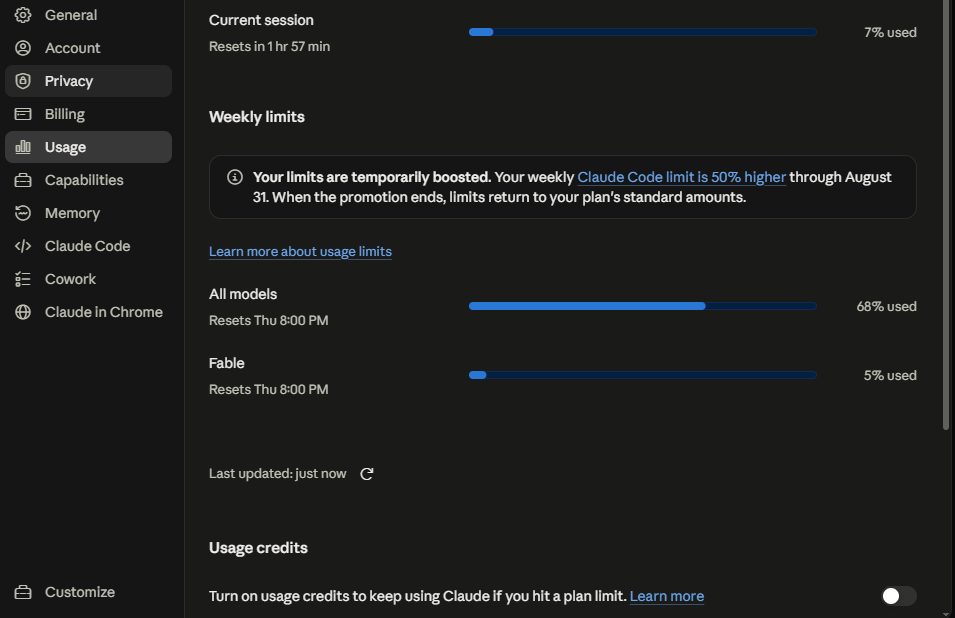
A session meter counting down, two separate weekly limits with their own reset times, a switch for usage credits that is off unless you went looking for it, and a note explaining that this month’s limits are not the normal ones.
Look at what is sitting in there that the marketing never mentions. Your session has a clock on it. Your week has more than one limit, and they do not all count the same models or reset at the same hour. There is a setting that lets you keep working past the ceiling by paying for what you use, and it is switched off until you find it.
And at the top, the part that started me writing this: a banner saying the limits are temporarily higher than normal. Not a permanent improvement. A promotion, with an end date.
Every apartment has an electricity meter. Most tenants have never gone down to the basement to look at theirs, and then the bill arrives.
Go and look at yours before you decide anything. You may find you are nowhere near the ceiling, and the upgrade you were about to buy solves a problem you do not have. You may find you have been running into the wall for weeks without knowing what the wall was.
Or you may find, as I did this week, that the number you have been working against was never the real number, and the date it changes back is already on the calendar.
Forward → Upward ↑ Onward ↗︎
Mstimaj
Sources and Further Reading
- Claude plans and pricing, Anthropic.
- Using Claude Code with your Pro or Max plan, Anthropic support.
- Google AI plans, Google One.
- Plans and rate limits, Google Antigravity documentation.
Join the Conversation
Share your thoughts and connect with other readers