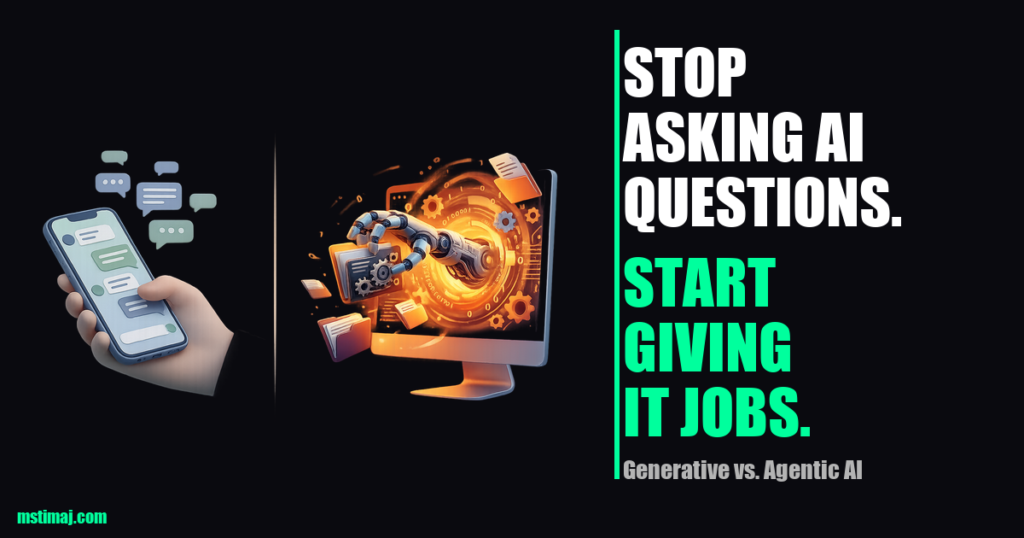
Most people are using AI the same way they use Google. Type a question. Get an answer. Maybe copy and paste it somewhere. Maybe ask a follow-up. Then close the tab and move on with their day.
That is not wrong. But it is the floor, not the ceiling. And the gap between what most people think AI does and what it is actually capable of doing right now is enormous.
I made a short video about this recently. I talked about what AI actually is, the difference between generative AI and agentic AI, and why that shift changes everything about how you should be using the tool. But a 60-second video can only do so much. So this is the longer version. The version where I can actually show you the difference instead of just naming it.
First, What AI Actually Is
AI is pattern recognition. That is the foundation of everything it does.
It reads massive amounts of text, code, images, data. It learns the patterns in that information. And then it uses those patterns to generate responses, predictions, and outputs that follow the same structure.
When you ask an AI to write a professional email, it recognizes the pattern of what professional emails look like based on millions of examples and produces one that fits. When you ask it to explain a concept, it pulls from patterns of how that concept has been explained before and assembles something coherent. And the more you interact with it, the better it gets at understanding what you specifically need. It picks up on your tone, your context, the way you phrase things. It adapts to you within the conversation.
That is useful. But it is also limited in a specific way. The AI is generating content for you to use. You still have to take what it gives you and do something with it yourself.
That is generative AI. And it is what most people are familiar with.
Generative AI: The Answer Machine
If you have ever used ChatGPT, Claude, Gemini, or any other AI chatbot through a browser, you have used generative AI. You type something in. It generates something back. Text, images, summaries, code, whatever you asked for.
Here is what most people’s AI workflow actually looks like:
You need a project proposal. You open ChatGPT. You type “write me a project proposal for a mobile app.” It gives you the text. You read it, copy it somewhere, clean it up, and send it off. The AI wrote the words. You handled everything else.
Now, to be fair, the chatbots have gotten better. ChatGPT, Claude, and Gemini can all generate PDFs, markdown files, and other document types. They all have canvases where you can edit and build content visually. Some have connectors that link to Google Drive, Notion, or your calendar. They are not purely generative anymore. There are agentic features built into the browser versions.
But here is the honest question: are you using any of that?
Most people are not. Most people are still typing a question, reading the response, and copying text into another app. They might not even know the canvas exists, or that they can connect their tools. And even the people who do use those features are working within a limited set of actions that the chatbot decides to offer. You get what the platform gives you. You work inside their box.
That is still useful. Brainstorming, drafting, summarizing, getting past a blank page. Millions of people use AI this way every day and it saves real time.
But there is a different way to work with AI entirely. Not a slightly better chatbot. A different relationship with the tool.
Agentic AI: The Worker
Agentic AI does not just answer your question. It does the job.
Instead of generating text for you to copy and paste somewhere, an agentic AI operates directly on your system. It reads your files. It creates new ones. It moves things where they need to go. It runs commands, connects to your tools, searches the web for information it needs, queries databases, manages deployments, chains multiple tools together in sequence, and maintains persistent memory of how your projects work across sessions. It can reason through multi-step problems, research topics across the internet, interact with APIs, and coordinate complex workflows that touch a dozen different systems.
The difference is not just speed. It is that the AI becomes a layer on top of your computer that can take action, not just produce output.
But here is what people get wrong about that: the AI does not just figure all of this out on its own. You have to build the system. You set the standards. You define the structure. You review the output and push back when it is not right. The agent is powerful, but it is powerful because someone is directing it. The results come from the combination of human judgment and AI execution, not AI alone.
Let me give you a real example from how I actually work.
What This Looks Like in Practice
I run a tech consulting business. I build websites, manage client content, produce social media posts, write articles, handle scheduling, and develop software products. I do all of this with a small team of one: me. And an AI agent that works directly on my machine.
But the agent did not show up knowing how to run my business. I built the system it follows. Configuration files, structured workflows, documentation, memory files that teach it how my projects work. I stay current with how the tools evolve, and I apply that knowledge to how I set things up. That is what makes it work.
Here is what happened this week.
I told my AI agent I needed to publish an article. It checked my drafts folder, found last week’s article had been posted but never archived, and moved the files to the right folders automatically. The article HTML went to posted. The featured image went to images. The social media posts went to the archive.
A generative AI would have told me where to move the files. An agentic AI moved them.
That is the difference.
And it goes deeper than single tasks. I have a music content brand called TheMusicAuntie. My AI agent helps me prep files, process video with FFmpeg, build compositions in Remotion, and keep the content pipeline moving. A chatbot forgets you the moment you close the tab. An agent remembers your system and builds on it, session after session.
But none of that is automatic. The agent gets better because you invest in making it better. You train it. You correct it. You build the guardrails and the processes. Your standards, your structure, your oversight. The agent brings speed, memory, and execution.
It Goes Further Than File Management
The archiving and TheMusicAuntie examples are just the everyday stuff. Here is a broader picture of what agentic AI can actually do:
- Build full applications. Databases, authentication, APIs, frontends. An agent can write the code, run tests, and commit to a repository while you define the product and review the output.
- Process video and audio. Trimming clips, composing sequences, rendering outputs, converting formats. Direct system commands, not a browser drag-and-drop tool.
- Generate and compose images by writing and running scripts that layer text, graphics, and photos together. No Photoshop. No Canva.
- Wire tools together across platforms. Slack notifications, database queries, deployment pipelines, API integrations, calendar management, email workflows. Connected and running.
- Diagnose and fix bugs by reading error logs, tracing root causes through code, applying fixes, and verifying they worked.
- Research across the web, pull from documentation, synthesize findings, and produce structured output. Not a list of links. Actual analysis you can act on.
- Draft and format content with SEO metadata, social media posts, and publishing workflows. Files saved directly on your machine in the right folders, not generated in a chat window for you to copy.
- Maintain persistent memory. An agent can remember your project structures, preferences, and workflows between sessions. The more structure you give it, the more it retains.
- Manage files and folders at scale. Rename, move, organize, archive, convert. Hundreds of files sorted by rules you define, in seconds.
- Query and manage databases. Run SQL, pull reports, update records, migrate schemas. No clicking through a GUI one row at a time.
- Handle scheduling and coordination. Check calendars, find open slots, draft meeting agendas, prep follow-up notes after calls.
- Monitor and maintain systems. Check deployment status, read server logs, flag issues, and apply fixes before they become problems.
- Generate data-driven reports. Pull raw data from multiple sources, analyze patterns, and produce formatted summaries ready to share.
- Manage entire content pipelines. From research to draft to metadata to social posts to publishing prep. Every piece created, named, and filed where it belongs.
I use all of this in my own work. None of it is hypothetical.
Why This Matters for You
You might be reading this and thinking “okay, but I am not a developer. I do not build software.”
That is exactly the point.
Agentic AI is not just for programmers. You just read the list. Building software is one thing it can do. But it can also organize your files, manage your calendar, draft emails, create spreadsheets, process invoices, compose images, convert documents, and update your website. It can query databases, pull data from APIs, monitor systems, and generate reports. It can run an entire content pipeline from research to publishing. And it remembers how you like things done the next time you sit down to work.
The question is not whether you code. The question is whether you are still manually doing things that a tool could handle for you.
Think about how you work right now. How many times a day do you:
- Copy text from one place and paste it into another?
- Download a file, rename it, and move it to a specific folder?
- Open a template, fill in the same fields you filled in last time?
- Search for information across three different tabs?
- Format a document to match a style you have used before?
Every one of those tasks is something an agentic AI can do. Not by giving you instructions on how to do it. By doing it.
The Shift Is Already Happening
Right now, most people are in the generative phase. They are asking AI questions, getting answers, and doing the rest themselves. And that is a legitimate use of the tool. It is already faster than doing everything from scratch.
But the people who are pulling ahead, the ones building businesses, shipping products, managing operations at a pace that used to require a full team, they are not just asking AI questions. They are giving it jobs.
They are saying “here is what needs to happen, here are the files, here are the tools, go.” And the AI is executing. But they are also reviewing, correcting, and refining. The people getting real results are not just handing off tasks. They are building systems and managing the AI like a team member who needs clear direction and quality control.
That is not science fiction. That is Tuesday for me.
If you are still in the generative phase, you are not behind. But you should know that the next level exists. And the gap between “AI helped me write this” and “I designed the system, directed the AI, and together we built, deployed, and organized this” is where the real advantage lives.
How to Start Thinking About This
You do not need to switch tools overnight. But you can start shifting your mindset right now.
Next time you go to ask AI a question, pause. Ask yourself: “Am I asking for information, or am I asking for something to get done?” If the answer is the second one, you are ready for agentic. You are ready for an AI that does not just talk to you, but works with you.
The tools exist. I use them every day. And once you see the difference between asking for help and directing an agent to execute while you maintain the vision and the standards, you will not go back to copy-pasting.
Forward → Upward ↑ Onward ↗︎
Mstimaj
Sources and Further Reading
- Anthropic. Building Effective Agents.
- Anthropic. Claude Code Overview.
- McKinsey Digital. Why Agents Are the Next Frontier of Generative AI.
- TheMusicAuntie. Spotify. Referenced content brand built with agentic AI workflows.
Join the Conversation
Share your thoughts and connect with other readers