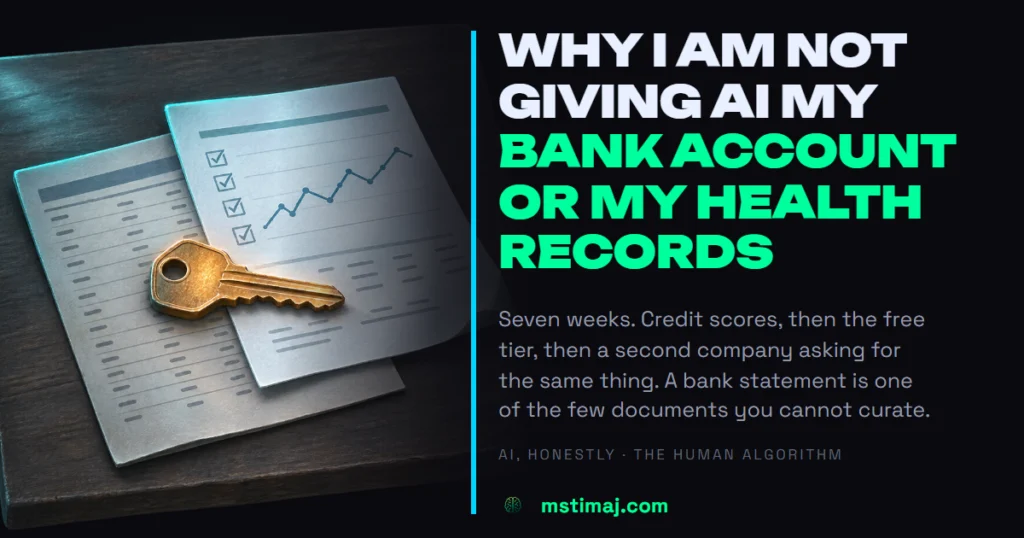
A bank statement and a chat message are different kinds of things. One is a record other people can hold you to for years. The other is a draft that stops existing when you close the tab. Over the past seven weeks, the two largest AI companies have both decided you would like them kept in the same place.
I am not doing it. Not my bank account and not my medical records, and I want to lay out why before I lay out what happened, because the dates below are going to look like an invitation and they are not one.
On 21 September, OpenAI added credit scores to Finances in ChatGPT. You connect your Experian report and your VantageScore, and it explains what is moving your number. On 2 October, Finances opened to Free and Go users in the United States, which is to say it stopped being something you paid for and became something you are offered. On 5 November, Anthropic shipped Personal Finance in Claude, a beta that links bank accounts, credit cards, loans and investments, for Pro, Max and Ultra subscribers in the United States.
Eleven days separated the paid version of one from the free version of the same thing. Five weeks after that, the other company asked for the same login.
What you are connecting when you connect an account
ChatGPT’s own documentation names the mechanism. Bank accounts come in through Plaid, which is the company that sits between your bank and almost every budgeting app you have ever tried. You do not hand your password to OpenAI. You hand it to Plaid, which holds a token on your behalf and passes the data along. Anthropic’s release note does not name its provider, so for now that is an open question rather than an accusation.
Plaid is the ordinary way this is done, and that is the part worth sitting with. It is a filing cabinet in a hallway. The company that built the cabinet is not the company that reads the files, and neither of them is you.
What arrives on the other side is not a number. It is the shape of your month. Where you shop, how often, how late, what you stopped paying for, what you started. A bank statement is one of the few documents that cannot be curated. You can write a careful email. You cannot write a careful grocery habit.
The default that moved
The money side is the part people are talking about. The health side moved first and moved more quietly.
On 14 September, OpenAI changed how permissions work for new Health connections. They now follow your global plugin setting, and that setting defaults to “Allow low-risk actions”. In plain terms, once your health information is connected, ChatGPT can use it when it considers the use relevant, without asking you each time. Sensitive actions still prompt. Reading does not.
The reason given in the release note is the interesting part. OpenAI wrote that more than seventy percent of Health users already chose to allow this without being asked each time. So the default was changed to match what most people were already doing. That is a defensible way to build software. It is also how a setting stops being a decision and becomes a condition.
Two weeks later, on 28 September, you could select any chart, metric or record in the Health tab and get a personalised explanation of it. Your bloodwork, read back to you in conversational English, by a system that is also finishing your sentences.
Why the free tier is the part that matters
Finances launched on paid plans. Eleven days later it was on Free and Go. The people who most need help understanding a credit report are, as a rule, the people who cannot pay two hundred dollars a month for careful advice. That is exactly who the free tier reaches. It is also exactly who has the least room to absorb a mistake, the least patience for a privacy policy, and the fewest options if something goes wrong later.
The product is best aimed at the people least able to carry its downside. I do not think that is cynical design. I think it is what happens when a company measures success by how many people connected an account.
Where I land
I am not connecting mine, and that goes for the bank account and the health records both.
That is a personal line rather than a prediction, and the difference matters. Some people are genuinely ready for this, having looked at what it does and decided the convenience is worth what it costs them, and they are not being reckless about it. I am not there yet, and I am not certain I ever will be. The reasons are ordinary ones.
A chatbot that is wrong about a recipe costs you dinner. A chatbot that is wrong about a deduction costs you a letter from the IRS eighteen months later, when you no longer have the chat. These systems still invent things. They still lose the thread on a long job. Nothing about linking a bank account changes that, and the confident tone does not get less confident when the stakes go up.
There is also the matter of who will own the answer. Anthropic filed its S-1 with the SEC on 26 October, which begins the process of becoming a public company with shareholders and quarterly obligations. Personal Finance shipped ten days later. Nobody knows whether one has anything to do with the other. What is knowable is that a company preparing to answer to shareholders is a different kind of company from one that is not, and that the data it holds on you becomes an asset on somebody’s balance sheet rather than a file on a server.
If you are going to do it anyway
This is not me talking anybody into it. Plenty of people will connect an account regardless of what I think, some of them for good reasons, and I would rather they did it with their eyes open than not say anything.
Connect one account rather than all of them, and pick the boring one. A single checking account tells it enough to be useful and does not hand over your whole financial life in one gesture.
Go and look at the permission setting rather than assuming it. In ChatGPT that is Settings, then Plugins, then the connection itself. The default is permissive and the default was chosen for you.
Read what comes back as a draft, not a verdict. If it tells you something about your spending, your taxes or your bloodwork that would change a decision, the next step is a person with a licence, not a follow-up prompt.
And keep in mind that you can disconnect an account in a few seconds, which does not retrieve anything that has already been read.
The part nobody has answered
Nobody has said what happens to connected financial data when one of these features is retired. Custom GPTs are being switched off on 11 December, a little over three years after they shipped. Cowork was folded into the main chat window in September and the tab simply stopped existing. Features at these companies have a shorter life than a car loan.
Your mortgage will outlive the beta that read it.
Forward → Upward ↑ Onward ↗
Mstimaj
Sources and Further Reading
- ChatGPT release notes, OpenAI Help Center, entries for 14 September, 21 September, 28 September and 2 October 2026
- Claude release notes, Anthropic Help Center, entry for 5 November 2026
- Anthropic files S-1 with the SEC for proposed initial public offering, 26 October 2026
- Finances in ChatGPT, OpenAI Help Center
- Custom GPT retirement and migration FAQ, OpenAI Help Center
Say something back
Comments go through our own form and are read before they appear. Links are not allowed; describe it in words.