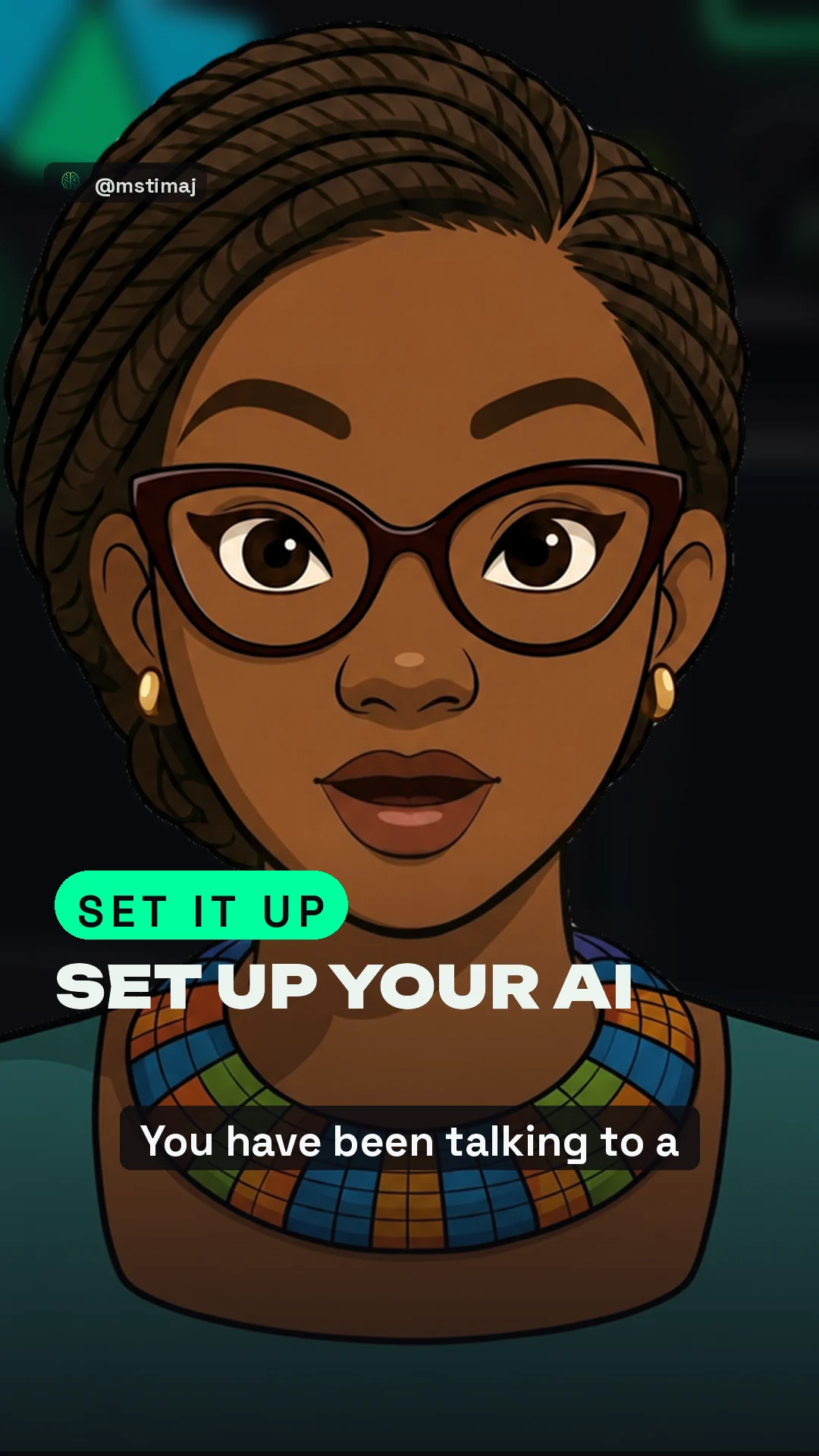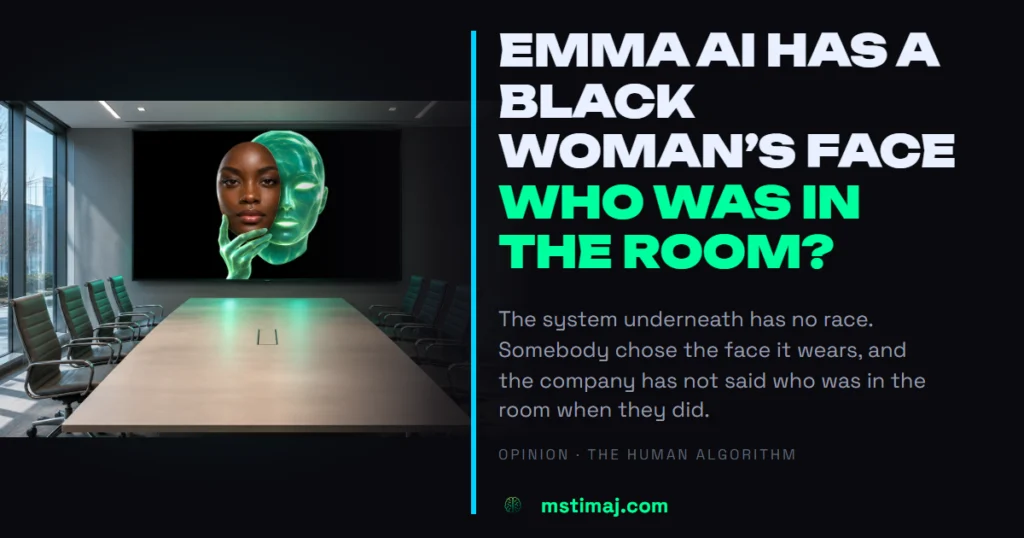
On 9 November a Seattle company called Nuance Labs released Emma AI, a video persona with a face, a voice, and one thing nothing else on the market does as well. She reacts while you are still talking.
I went to meet her and I could not. Emma AI is blocked in Connecticut, where I currently live. It is also blocked in other states, including Colorado, Illinois and Texas, and in parts of Canada. That may change by the time you read this. Where those doors are closed turns out to matter, and I come back to it at the end.
The reason I heard about her at all is that people kept telling me how realistic she is, and how much that unsettled them. The technology arrived wearing a face, and the face raised questions the company has not answered.
What Emma AI actually does
You may have read my piece last week about ChatGPT retiring two of its voice models. The replacement, Live, already does something the older ones could not. It listens while it talks, and a pause no longer reads as you being finished. The turn-taking problem is being solved across the industry, and Emma AI is not the first to solve it.
What is different here is that the face moves too. Nuance Labs calls the underlying system a full duplex audiovisual model. Full duplex is a phrase borrowed from telephones and it means both directions at once.
A walkie talkie
- One person transmits at a time.
- You have to finish before the other side can start.
- Silence is the signal that you are done.
A telephone
- Both ends are open at once.
- You can interrupt, agree, or trail off.
- A pause is just a pause.
Every AI voice you have used so far has been closer to the walkie talkie. Emma AI is built to be the telephone, and to do it with a face as well as a voice.
So she can start to look confused before you have finished explaining, or raise an eyebrow at the part you were least sure about, or stay still while you think. Nuance Labs says she matches human response timing in most of the conversations they tested her on. The reaction people keep describing to me is not that she sounds real. It is that she looks like she is listening.
There is a second half to this that gets much less attention. It is not only that you watch her. She watches you. Their own page says that with your camera on, Emma can talk about what she sees. The thing that reacts while you are still speaking is reacting to your face.
Where the face came from
Emma AI’s face and voice come from a real actress. The company says she licensed her own likeness, worked with their team to capture how she listens and reacts and speaks, and chose the name Emma herself. They say they considered more than two hundred performers before selecting her. The actress has not been named publicly.
Many people object to a real human likeness being used this way whatever the paperwork says. One reason holds up particularly well: not everyone who meets Emma AI is going to understand that she is synthetic. Right now you have to go to the website and choose to open her. That will not stay true. A persona like this ends up embedded in customer service, in a teaching app, in an advert, in places where nobody went looking for it.
And a license covers what the actress agreed to today. It does not cover what the face gets asked to say in two years, or who buys the company, or what a persona built on her bone structure ends up selling.
Why people started saying digital blackface
Within days of the launch, the phrase attached to Emma AI in a lot of the coverage was digital blackface. AfroTech and Ebony both ran it. If you have not come across the term before, it carries a great deal more than this one product. It is older than AI.
Blackface was never only paint on a face. In American theater and film, Black performers were barred from the roles that were about them, and others were paid to play those roles instead. What got performed was a caricature: the speech mangled, the features distorted, the characters written as stupid, lazy, dishonest and childlike. Those performances taught a country that demeaning Black people was acceptable. The stereotypes outlived every performer who ever put on the makeup. Black actors who took those same roles, and some did, because it was that or no work at all, did not undo the harm by being Black. The harm was in what was being performed and who was profiting from it.
Digital blackface is the same arrangement without the makeup, and it started before AI. It started with accounts. Someone sets up a profile, presents as Black, writes in what they imagine Black speech sounds like, and performs that character for an audience that believes it is real. It has been done for money, for engagement, for rage bait, and for politics. Coordinated networks of exactly these accounts turned up in reporting around recent elections, built to move opinion inside communities their operators did not belong to.
What AI changes is the production cost. A persona that used to need a person typing now needs a model and a face. The underlying system has no race. A face from one community is applied to it, and from that point on the thing speaks with that face to whoever opens it.
So the question is not whether an AI is allowed to look like anyone. It is this:
Did the community whose face this is take any part in building it, and who decides what that face is used to say next?
The answers should have existed before launch
Nuance Labs has explained the licensing and explained the casting. Asked directly why they chose a Black woman, the answer reported back was that they liked the actress. That is an answer about casting. Nobody was asking about casting.
A company that picks a Black woman as the listening face of its product in 2026 knows that question is coming. There are three ways to arrive at launch day without an answer ready. You considered the question and decided it did not need addressing. You never thought of it at all. Or you understood exactly what it would produce, and judged that outrage and curiosity would carry the launch further than quiet approval would.
The first is negligence. The second is a gap in the room. The third is a strategy, and it is the one I find hardest to take, because a company that treats a community’s discomfort as a distribution channel has decided that its responsibilities end where its reach begins.
The fix for all three is the same and it is not complicated. Black people belong in the rooms where decisions like this one get made, shaping the thing before it ships rather than reacting to it afterwards. That is what diversity in a company is actually for. Not a photograph on a careers page. Someone in the meeting who can say, out loud, before launch, here is how this is going to land and here is what we should be ready to explain.
Why this matters past one product
I am not making a claim about who was or was not in that room, and I would ask you not to either. The questions are open, and open questions of this kind have a history attached to them.
This is concerning for the Black community and it is concerning for me, as someone in it. The pattern of people outside a community making decisions about that community’s image, for their own purposes, without asking anyone inside it, is not new and it has not usually ended well for the people whose faces were borrowed.
Emma AI is the first of these you will meet, not the last. Every serious AI product is about to arrive with a face and a personality, because the personality is what is being sold. The questions worth carrying forward are who chose the face, who was asked, and what happens to it later.
Back to where the doors are closed
Colorado, Connecticut, Illinois and Texas. Not available. Canada, except Quebec. That is an odd list until you line it up against what the product does, and then it stops being odd at all.
Every one of those places has a law about capturing the geometry of a human face without informed consent. Texas has the Capture or Use of Biometric Identifier Act, which covers face geometry by name. Colorado and Connecticut added biometric data to their privacy acts. Quebec requires a company to notify the regulator sixty days before a biometric database goes live, which is the only advance filing of its kind in North America.
And Illinois has the one that actually frightens companies. Its Biometric Information Privacy Act has been on the books since 2008, and it is the only one of these that lets an individual sue directly, with damages set per violation rather than in total. That is why Illinois gets switched off by default by companies that would rather not find out.
Nuance Labs does not say why those places are excluded. Their own page gives the list and attaches no reason to it. So this is the shape of it, and you can do what you like with it: a product whose camera reads your face is turned off in the places that regulate reading faces, and nobody has been asked to explain the overlap.
Which brings the whole thing back to one point. Every hard question about Emma AI, who chose that face, who was in the room, whose face it reads and under what law, has the same answer available. The company could simply say. So far it has not, and in the meantime people are answering for it.
Forward → Upward ↑ Onward ↗
Mstimaj
Sources and Further Reading
- Nuance Labs, “Meet Emma, the first Nuplex persona”, including the camera note and the regional availability list. Checked 16 November 2026.
- Nuance Labs, company and team page.
- AfroTech, “Meet Emma, The Black Woman AI Persona Raising Questions About Race, Identity, And Digital Blackface”.
- Ebony, “Nuance Labs Faces Backlash Over Black AI Avatar Emma”.
- GeekWire, “Ex-Apple PhDs raise $10M, choose Seattle to build an AI foundation model that understands emotion”.
- Illinois Biometric Information Privacy Act (BIPA, 2008), the only one of these with a private right of action.
- Texas Capture or Use of Biometric Identifier Act (CUBI), which names face geometry directly.
- Mstimaj, “ChatGPT Is Retiring Two Voice Models On December 11”, the piece referenced above on full duplex voice.
Say something back
Comments go through our own form and are read before they appear. Links are not allowed; describe it in words.