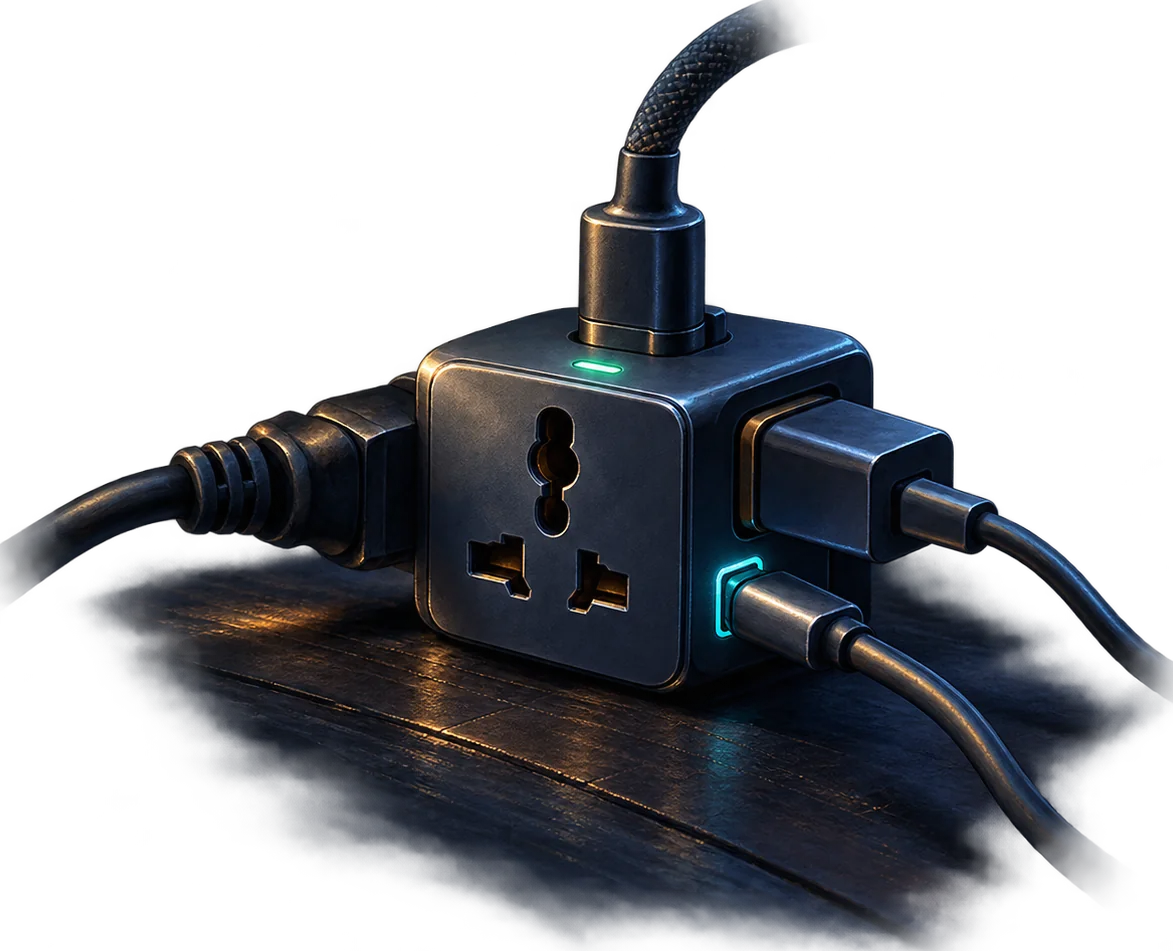
MCP is a plug standard. Before it, every AI app needed a custom connection to every tool: one for your calendar, one for your files, one for your database, rebuilt for each app. MCP defines one way for a tool to describe what it can do and one way for a model to call it. A tool wrapped as an MCP server then works in Claude, ChatGPT, Cursor and the rest without being rewritten.
Key facts
- Nov 2024Anthropic published MCP as an open standard
- 12custom connections for 4 apps and 3 tools without a standard (4 times 3)
- 7connections with MCP for the same 4 apps and 3 tools (4 plus 3)
- 2halves of every MCP setup: a server that offers tools, a client inside the AI app that calls them
- Dec 2025Anthropic handed MCP to the Linux Foundation's Agentic AI Foundation, with OpenAI, Google and Microsoft among the members
- Connection arithmetic worked on this page; dates from Anthropic's announcement (25 November 2024) and the MCP blog (9 December 2025); checked 30 September 2026
What does the USB-C for AI line mean?
The MCP documentation opens with that comparison and it is the right one. Before USB-C, every device shipped its own charger and its own cable. After it, one port takes them all. MCP does that for AI tools. The tool side is called a server: a small program that says, in a fixed format, here are the things I can do, here is what each one needs. The AI app side is the client: it reads that list, shows the tools to the model, and passes calls back and forth. Neither side needs to know anything else about the other.
The arithmetic is the point. With four AI apps and three tools, custom integrations mean four times three, twelve connectors to write and maintain. With a standard it is four plus three, seven, and each new tool adds one, not four.
| AI apps | Tools | Custom connectors (apps x tools) | With MCP (apps + tools) |
|---|---|---|---|
| 2 | 2 | 4 | 4 |
| 4 | 3 | 12 | 7 |
| 4 | 10 | 40 | 14 |
| 6 | 20 | 120 | 26 |