The Human Algorithm/How to Keep Your AI Character From Becoming a Stranger
The Human Algorithm • FridayHow to Keep Your AI Character From Becoming a Stranger
Ask an AI for the same character twice and you meet two different people. The fix is two moves: choose a canon image, and send it with every single request.

You made a character you like. A mascot, a narrator, a face for the brand. You got a great picture of her on Tuesday.
Then you asked for her again on Thursday and met somebody else.
This is the wall everyone hits, and it stops most people. The fix is two moves. Choose one canon image, and send it with every request. Neither one is clever. Both get skipped.
Why it happens
Start here, because the fix only makes sense once this lands.
When you describe a character and get a picture back, nothing is being looked up. The tool is building a face from scratch that fits your words, right then. Ask twice and you get two faces that both fit perfectly. They are just not the same face.
Think about describing a friend to a police sketch artist. Brown eyes, round face, glasses, hair up. What comes back is a real face matching every word you said. It is not your friend. Walk into a different studio tomorrow, give the same words, get a second stranger.
So the tool is not losing your character between sessions. It never had her.
That is why describing harder does not work. More adjectives give the artist more rules to follow, not your friend’s actual face. You can spend a week improving the words. Plenty of people do.
Move one: choose a canon image
Canon is a word borrowed from comics and animation. It means the version that counts. When people argue online about what is canon, they are arguing about which events really happened in the story and which ones do not count.
Your canon image is that idea applied to a face. Out of everything you have made, one picture is the official one. Every picture after it has to agree with that one.
So pick it, and promote it on purpose. From now on that image is the character.
Do not pick your coolest render. Pick your clearest one. The guidance here is specific and worth following exactly: at least 1024 by 1024 pixels, facing forward, even lighting, plain background with nothing going on behind her, and her face taking up a decent share of the frame.
A dramatic shot with moody shadows and a busy background makes a worse canon image than a plain, slightly boring one. Every time.
That is the whole first move. You are not writing rules yet. You are deciding, once, which picture is the real one.
Move two: send it every time
Almost every image tool now lets you attach a picture alongside your words. It might be called a reference, an attachment, or a source image. You hand it your canon image and say “this woman, standing at a desk” instead of describing her from nothing again.
I tested this properly. Same words both ways, same tool, one difference.
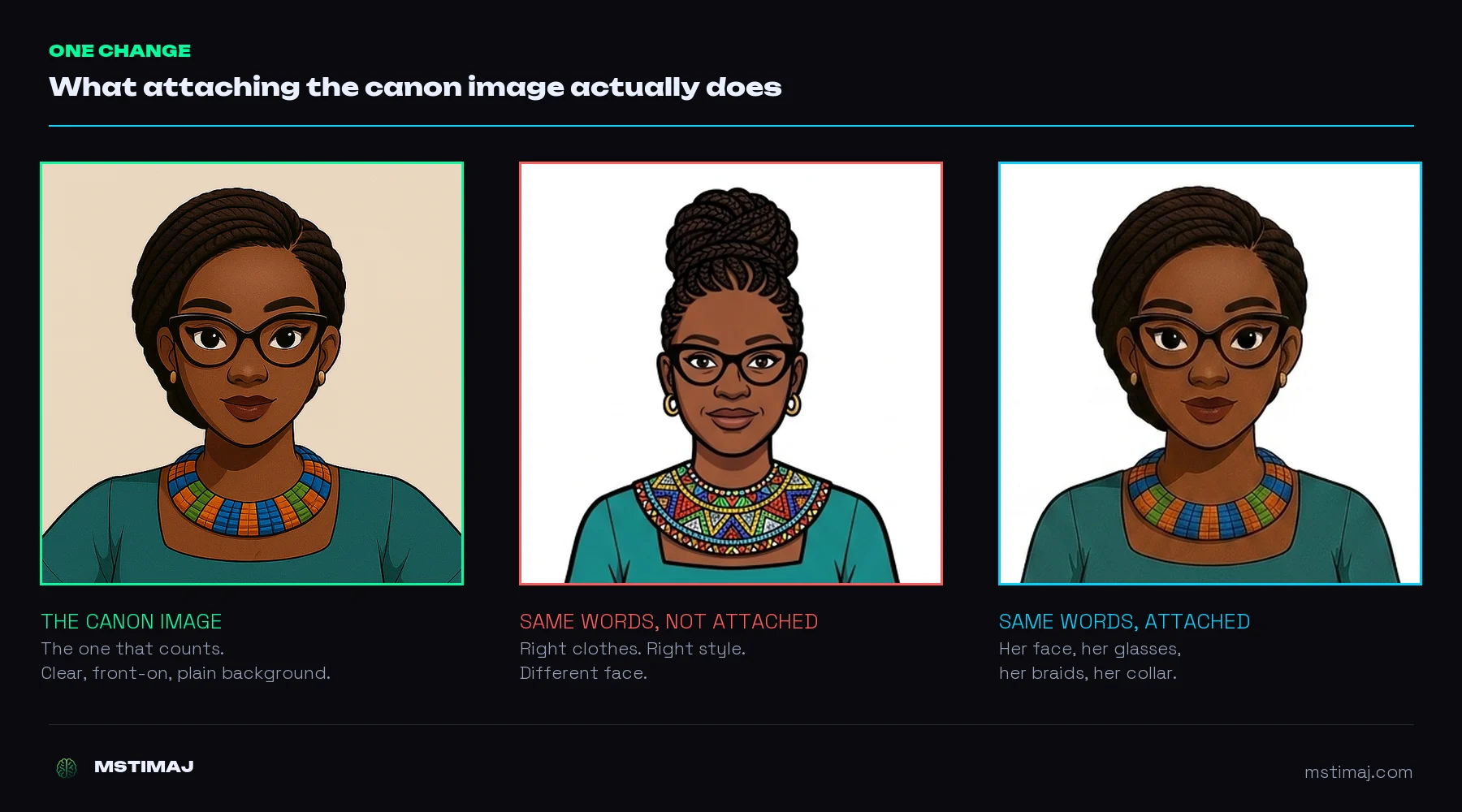
Without the picture attached: right clothes, right art style, completely different woman. With it: her. Same face, same glasses, same braided updo, same beaded collar, same dress.
One change. That is the difference between having a character and having a series of strangers.
Now the part where people come unstuck.
That attached picture only applies to the image you are making right now. Then it is gone. It is not a setting you switch on. The tool does not save her, does not remember her, does not learn her. The people building these tools say it plainly: attach the picture on every single request.
So here is how it goes wrong. You attach it, get a great result, feel like you have cracked it, then fire off the next four requests without it because things are going well. Those four come back as strangers. Nothing broke. You stopped sending the picture, so the tool went back to inventing.
Send it every time. Even when it feels unnecessary. Especially then.
If your tool takes more than one attachment, and many now do, use the extra slots for the same character from other angles rather than for mood or style. Two or three angles beats one by a real margin. Some tools now take up to seven.
What a picture cannot argue for you
Your canon image carries a lot. Face, hair, clothes, colours, art style. It does not carry everything, and the gap is where this still bites.
Two things that happened to me this week.
I wanted a character taller. Her build was already right, full-figured and curvy, and I liked it that way. So I asked for statuesque, which sounded like the elegant way to say tall. She came back tall. She also came back thin.
I never asked for thin. That one word carries a whole body shape inside it, and the tool turned it into one, quietly trading away the thing I had not thought to protect.
The second one is smaller and more annoying. A picture came back with short cropped hair instead of the braided updo. I had not asked for short hair. I had also never written down “keep the braids,” because it had not occurred to me that I would have to.
The pattern in both: the attached picture showed what she looked like. Nothing told the tool which parts were non-negotiable. So when a word pulled in another direction, there was nothing pushing back.
Animation solved this a hundred years ago
Here is the part that made me feel better about the whole problem.
None of this is new. Animation studios have dealt with character drift since long before AI, because dozens of artists draw the same character across one production and every one of them draws slightly differently. They even have a term for a character looking like herself. She is on-model.
Their solution is the model sheet, sometimes called a turnaround. It is the character drawn from a standard set of angles, usually five across a full rotation: front, three-quarter, profile, three-quarter back, back. Once it is approved it goes out to everyone in the pipeline and becomes the reference nobody is allowed to drift from.
The detail I would steal immediately: model sheets carry horizontal guide lines running across all the views, marked at eye level, shoulder, hip, knee and foot. They work as a ruler, so features sit at the exact same heights in every drawing. That is proportions written down as a rule instead of left to somebody’s judgement.
Which is exactly what would have caught my height problem. If the sheet fixes where the hip sits relative to the shoulder, “make her taller” cannot quietly become “make her thinner.”
The other thing worth copying is why studios bother at all. The stated purpose is to solve design problems before production starts. Which is a polite way of saying that writing it down afterwards is the expensive order. Ask me how I know.
Brands do the same thing. Duolingo publishes its guidelines, and Duo is the same owl across thousands of drawings because they broke him into standardised shapes with fixed relationships. They wrote the do-nots too. Their guide tells artists not to draw his pupils centred because it makes him “look creepy.” Not “keep him friendly.” Something you can actually check.
What to do on Monday
Pick your canon image. Clearest, not coolest.
Attach it to every request, without exception.
Write a short file and keep it next to that picture. In it, put the things a picture cannot insist on for you. Exact colour codes rather than colour names, the ones that look like #D4A845, because a colour word is a negotiation and a code is not. The build or the proportions, written as something that must not change. The hair described so precisely that nothing else could come back and pass. And a short list of what must never happen.
When your tool lets you attach more than one picture, spend the extra slots on other angles of the same character.
Then expect some drift anyway, and bin the misses without making it a whole thing.
What it still costs
Drift happens even with the canon image attached, and it happens most on the parts you never wrote down. That is not a coincidence. That is the whole lesson.
Most tools also throttle you. Mine stops after roughly a dozen pictures and locks me out for a couple of hours, so this is work you batch rather than binge.
And your written file is only as good as the day you wrote it. Mine is getting a section on build this week, because that is the thing that walked off while I was watching something else.
Comments
No comments yet. Yours can be the first.