The Human Algorithm/The Human Algorithm: Technology, Spirit, and the Human Who Holds Both
The Human Algorithm • MondayThe Human Algorithm: Technology, Spirit, and the Human Who Holds Both
Technology has always been inherent to being human. The body is technology. The brain is a machine. Nature runs on math and physics. The harm in the current AI rollout is not the tool. It is who got it, who did not, and what investment in the population never happened.

The Human Algorithm is out. The full nine-track album is on Spotify, YouTube, Amazon Music, and most of the major streaming platforms. The album page at mstimaj.com/frequency has cards linking out to each one.
I wrote the album over the last couple of months to help me process something I am still inside of. I walked for my degree in 2024, and the BSc in information technology that goes with the walk is now done. It took me longer than the standard timeline because of the wider systemic structures that have run through the rest of my life, not because of the school itself. The album is one of the ways I have been metabolizing that. The article you are reading is another.
The bigger frame is not just mine.
The age of AI has arrived, and a lot of people are calling it evil. Six six six. The antichrist. The proof that we have finally built the thing that is going to undo us. The conversation around the dinner table and on the timeline has shifted from look at this new tool to look what they are doing to us.
I do not think that read is right. Not because the harm is not real. It is. I will get to that. I think the fear has been pointed at the wrong target.
We Have Always Been Technology
Technology did not arrive with silicon. It arrived with us.
Your body is technology. It operates on autopilot. The heart beats in cycle without your permission. The lungs breathe on rhythm without your management. The endocrine system signals across the whole organism without your input. The microbiome runs a parallel population of processes inside you at every second of every day. None of that needed an engineer to design it twice.
Your brain is a machine. It runs on autopilot too, and it runs with greater outcome when there is a pilot driving it. The pilot is the thing the spiritual traditions have been trying to name for as long as there has been language for it. Awareness. Witness. Higher self. The one underneath the thoughts.
Nature is technology. It runs on mathematics. It runs on physics. Equations are not laid on top of nature; nature is the equations. Photosynthesis is a protocol. The way fungi pass nutrients between trees in a forest is a network. The way a flock of birds turns at once is a distributed system. We did not invent these patterns when we built our own. We noticed them and ran versions of them on slower hardware.
The fear in the room is louder than philosophy. People are afraid AI is going to end us. People are afraid the harm is already here. Data centers pulling staggering amounts of energy and water. Communities displaced for compute. Work scraped, voices cloned, faces in training sets without consent. I am not asking anyone to put that fear down. I am asking what we are aiming it at. The split between human and technology is not where the harm is happening. The harm is happening inside how the technology is being run. By whom. For whose benefit. At whose cost. That is a different fight.
The Problem Is Not the Tool. It Is Who Got It.
The advancement of tech has required a level of individualism that has kept the tech from being shared.
Tools that should be common have been hoarded. Knowledge that should be free has been priced. Education that should be a baseline has been gated and tiered and sorted. Every leap in capability has been a leap in distance between the people on the leading edge and the people the leading edge supposedly serves.
What you end up with is a split.
One sector of the population is incredibly ahead. They live in a different reality, with different tools, different vocabularies, different time horizons. The system was designed to keep them there because they keep the machine moving. The other sector is being left behind. Not because the tools cannot reach them. Because the people building the tools never built a road in.
That is not a tech problem. That is a stewardship problem dressed up as a tech problem. And if you do not see the difference, you will keep blaming the wrong thing every time the harm shows up.
AI Is the Latest Version of This, Not the Exception
The current rollout is the loudest example.
You give people a tool you call democratizing. You do not educate them on how to use it. You do not lift the basic literacy that would let them recognize the tool when they see it. You do not invest in the schools, the libraries, the health care, the environments around them. You hand them a screen and call it access.
And then you ask why they are not grateful.
They are not grateful because they are still being harmed by the databases, the bureaucracies, the immediate systems around them that were there long before the new screen showed up. They are not unwise. They are dealing with what is in front of them, which is not your tool. It is the eviction notice. It is the school that failed their kid. It is the clinic that does not see them. It is the letter from immigration. It is the food on the counter that has to last the week.
If the people building this cared about the people downstream of it, the rollout would look different. The investment would look different. The order of operations would look different. Education first. Health care first. Stability first. Then the tool. The tool lands well on a population whose feet are on the ground. It bounces off a population whose floor is still missing.
Two Reactions Both Miss It
There are two responses I see a lot, and neither one is the answer.
The first response says abandon technology. Go back to nature. Pretend the last six thousand years of acceleration never happened. The problem with this read is that technology is not the disease. Technology is the prescription. The body running its own protocols is technology. The brain running on a pilot is technology. The forests we are trying to save run on equations and physics. The way through is not to walk away from technology. The way through is to use the technology we have to heal what we have damaged.
The forest is also still available, for now. You can move rural. You can grow your food. You can hold the analog version of your life with both hands. But the damage we are doing is global, and your small forest is not immune to it. The fires reach it. The droughts reach it. The water table reaches it. The atmosphere reaches it. There is no version of opting out that is actually opting out.
The second response says it is all a simulation. Everyone outside you is an NPC. None of it is real. Detach. Watch from a great height. Treat the suffering as a low-resolution texture. This response is the dodge of dodges. If everyone else is a background character, you do not have to be responsible for what happens to them. If the harm is not real, you do not have to fix it. You just have to keep playing the game. Advance the machine. Stay focused on advancing the machine. Anything that pulls your attention off the machine is noise.
Both responses let you off the hook. Both are wrong.
The people next to us are not extras. The harm is real. The tool is not the enemy. And the work is not waiting for somebody else to come do it.
The Integration Is the Work
If the body is technology, and the brain is a machine, and nature is mathematics, and silicon is the new substrate of an old pattern, then the line we keep trying to draw between technology and humanity is not actually there. We drew it because it gave us somebody to blame. The line was never structural. It was rhetorical.
The work is not to choose between them. The work is to integrate them on purpose.
That means using the tools you have to build the world you want to see in instead of the world you inherited. It means making sure the access goes both ways, not just down to the people who can already pay for it. It means designing the rollout the way you would design any other public good, with the population in mind, not the quarterly target.
It means moving from a cyberpunk future, the one we drift into if nobody does the work, toward a solarpunk one, the one we get if we do. Tech grown around earth. Earth informing tech. Neither one master, neither one subject. The two integrated on purpose.
This is not a fantasy genre. It is a blueprint that requires a decision.
Four Voices, Separate Until the End
The album is built around four characters.
Kalpana is the source. She comes from above. She opens the album on the first track, and she closes it on the last one. She is what some traditions call the higher self, what others call the soul, what others call the part of you that knows the shape of the game from outside it. She is the witness.
Kaida is technology. The man-made part. Surgical. Forward-moving. Iterative. Faster, better, again. She is the song called Past, Present, Future. She is also the part of the world that walks away without noticing what it bruised on its way through.
Saoirse is nature and spirit. Frequency. The thing that already knows. She names herself in the second track. I am not here, I am an entity. What you see is the 3D. Feelings, vibration, frequency. She is the part of being human that the dashboards cannot scan.
Lila is the human being. She does not speak for the first four tracks. She is unseen. She is unvoiced. She is figuring out she has a voice at all. Then she finds it. Then she walks back into her own life and pulls the other three in.
For most of the album, those four are physically separate. That sequencing is not decorative. It is the diagnosis. Right now, in the world we live in, those four are separate. Spirit is far away. Tech is moving without conscience. The human is silent and unseen. The source is overhead, watching.
The integration only happens at the end of the album. Track seven. Track eight. Track nine. Lila draws them in. She becomes the architect of her own integration. That is the resolution the album is reaching for. That is the future I am writing toward.
Past, Present, Future Is What Advancement Costs Without Care
Track three of the album is Past, Present, Future. Kaida’s voice. The technology voice.
It is not a song about technology. It is a song built like technology. Surgical motion. Forward speed. Iteration without metabolizing what the last iteration did. Faster. Better. Again.
The critique inside it is what we are inside of right now. Advancement that walks away without noticing what it bruised. Speed that cannot afford to feel. Forward motion that treats the body it just brushed as background.
This is not a hypothetical. This is the rollout.
Entity Is the Part We Keep Trying to Strip Out
Track two is Entity. Saoirse’s voice.
I am not here, I am an entity. What you see is the 3D. I am not bold, I am majestic. What you see is the feminine. Feelings, vibration, frequency.
This is the part of being human that is not measurable. The thing that is not on the dashboard. Pick the word that works in your tradition. Intuition. Source. Knowing. Anchor. The still small voice. Some people call it God. Some people call it the gut. The vocabulary changes, the function does not.
Technology cannot scan it. The current tools have no API for it. That is not a failure of the tools. That is the design of the layer they live on.
In the album, Saoirse senses Lila before Kaida does. The body knows you are there before the system has logged you. The spirit knew you were a person before the credential confirmed it. That order matters.
A culture that pretends only the measurable is real has decided in advance that half of being human does not count. That is the move I am asking us to undo.
Where I Am Writing From
I am not writing this from the outside.
I grew up loving to learn. My father was a librarian, and he built the floor underneath my curiosity. Then he passed. My mother had her own to carry. The supports a family needs when life gets that heavy did not exist around us. I came out of childhood with the love for learning still intact and very little stability around it.
My immigration status has been unstable for most of my life. I am DACA now. We came here on visas, so the path started clean. After that, the road got complicated, and it has never gotten simple again. That instability shaped what was available to me. Not in a limiting-beliefs way. In a structural-limits way. Loans I did not qualify for. Scholarships I won in high school and could not collect. The driver’s license most kids get at sixteen. I got mine at twenty-seven. These are not internal stories I was telling myself. These are doors that did not open.
I have been thrust into corners and told to have no voice, and then judged for not being more powerful. I have been told I should fit somewhere, and then quietly told the place I was supposed to fit was not actually going to make room.
The structures around me failed me, and now those same structures require me to be more than they ever allowed me to be. That is the loop I have been running in. At some point you stop waiting for the structures to redesign themselves. At some point you take whatever tools you do have, and you start building the version of life you actually want to live inside of.
I am blessed to have an education. The path was not smooth. The timeline was not the standard one. But it is done, and it taught me what the tools can do. The institution itself sits inside the same systemic structures as the rest of it. The educators inside the institution have been some of the truest people I have ever met. Teachers and staff who showed up. Who saw me when systems could not. Who kept doing the work day after day in a profession that gets less and less of the respect it deserves. They are a light in this world. They are part of why I am still here doing the work. So the question for me now is not whether to engage with the technology. The question is what I am going to build with it that the structures around me did not build for me, and will not build for the next kid walking the same kind of path.
The double of this is the macro picture. The failure to roll out technology with care is the same shape as the failure to roll out the schools, the health care, the immigration paths, the housing, with care. The pattern repeats because the people running the rollouts have not done the part of the work that requires them to see who is downstream of them.
This is what I mean when I say the problem is not the tool. The tool can bend. The people running the systems have not yet decided that bending is the work.
The People in the Video Game Are Not Going to Fix This
The people building the next generation of these tools have a habit of talking about reality as if it were a simulation. They use the language casually. Everyone outside is an NPC. Base reality is somewhere else. We are computing inside a machine.
It is a beautiful way to opt out of caring.
If everyone else is an NPC, you do not have to be responsible for what happens to them. If everything is a simulation, the harm is not real. If the people downstream of your tool are background characters, you do not have to invest in their literacy or their access or their environments. You just have to keep playing.
This is the worldview that is driving a lot of the current rollout. It is the dodge of dodges.
They are not NPCs. They are people. The databases that harm them are real. The schools that failed them are real. The health care they did not get is real. The migration they are caught inside is real. The grief is real.
A worldview that requires you to depersonalize everyone outside you so you can sleep at night is not a worldview. It is an exit strategy.
First to Me, Then to Thee
The principle that catches me every time is older than the album. Polonius says it to his son in Hamlet:
This above all: to thine own self be true. And it must follow, as the night the day, thou canst not then be false to any man.
First to me. Then to thee.
Stewardship has to start in your own house. You cannot ask the system to be just if you have not started with yourself. You cannot demand the tools be ethical if you have not been honest about why you are using them. That is the inside half.
The outside half is the part the rollout keeps skipping. Once you have stewarded yourself, you owe what you know to the people around you. Oneness is not absorption. Oneness is responsibility. What is true inside you is true outside you, and you do not get to keep them on separate ledgers.
That is what the album is asking. That is what the moment we are in is asking.
The people who built this skipped both halves. They have not stewarded themselves, which is why the tool is so loud and the wisdom is so quiet. And they have not stewarded anyone else, which is why the rollout looks the way it does.
What I Am Doing About It
I am building. I am writing. I am shipping the version of the story I would have needed somebody to put in front of me when I was younger.
The album is one piece of that. The site you are on is another. The products I am building are another. The consulting work is another. None of these are the whole answer. Together they are the version of the integration I can carry from where I am standing right now.
I am not in the rooms where the rollout gets decided. The rest of us who are not in those rooms build from where we are. What I am doing is building with care, writing with care, and telling the truth about the layers underneath. So that the people who pick up the same tools I am picking up have a chance of using them with the integration already running.
Listen to the Album
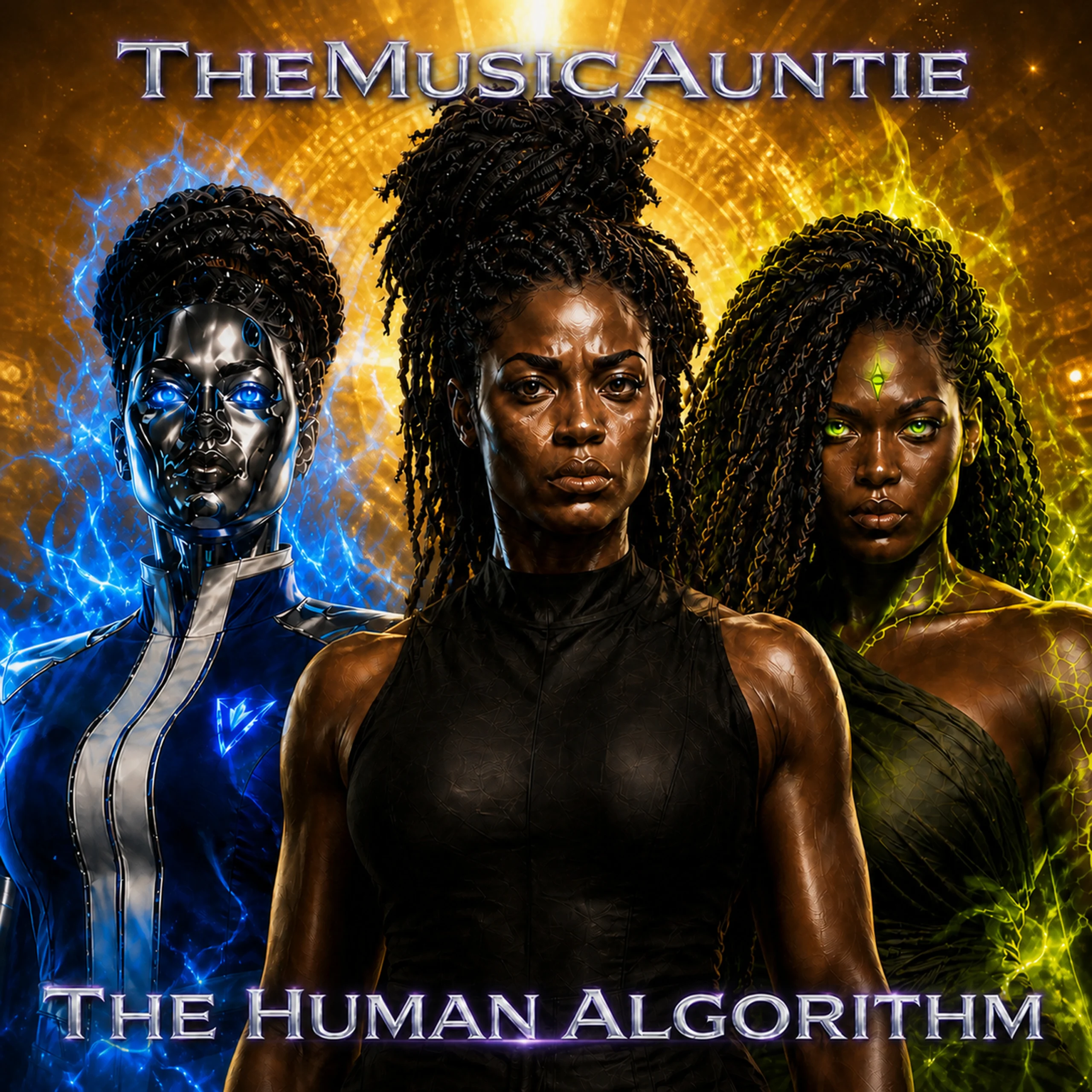
The album page on my site is at mstimaj.com/frequency, with cards linking out to every platform. The album streams on Spotify, YouTube, and Amazon Music. You can also find TheMusicAuntie on Suno. Nine tracks. Four voices. The full arc.
Hear what separation sounds like in the first half. Hear what the integration sounds like in the second.
Then ask yourself which version of the future you are building toward with the tools you already have in your hands. The cyberpunk one is the one we get if we keep doing what we are doing. The solarpunk one is the one we get if we do not.
The deciding is not in the future. It is now.
Forward → Upward ↑ Onward ↗︎
Mstimaj
Sources and Further Reading
- The Human Algorithm album page – the album’s page on mstimaj.com, with cards linking out to each streaming platform.
- The Human Algorithm on Spotify – the album direct.
- TheMusicAuntie on Amazon Music – the artist page with the album.
- TheMusicAuntie on YouTube – tracks and videos as they go up.
- TheMusicAuntie on Suno – the Suno profile.
- William Shakespeare, Hamlet, Act 1, Scene 3 – the Polonius speech quoted in this article (“to thine own self be true…”).
- You Are the Algorithm – the prose sibling of this thesis from March 2026. Same idea, different door.
- Stop Asking AI Questions. Start Giving It Jobs. – the entry point to the Thinking with Circuits arc, on the difference between using a tool and being run by one.
Comments
No comments yet. Yours can be the first.